
10 Essential Hand Tools Every Professional Needs — Types, Uses & Buying Tips
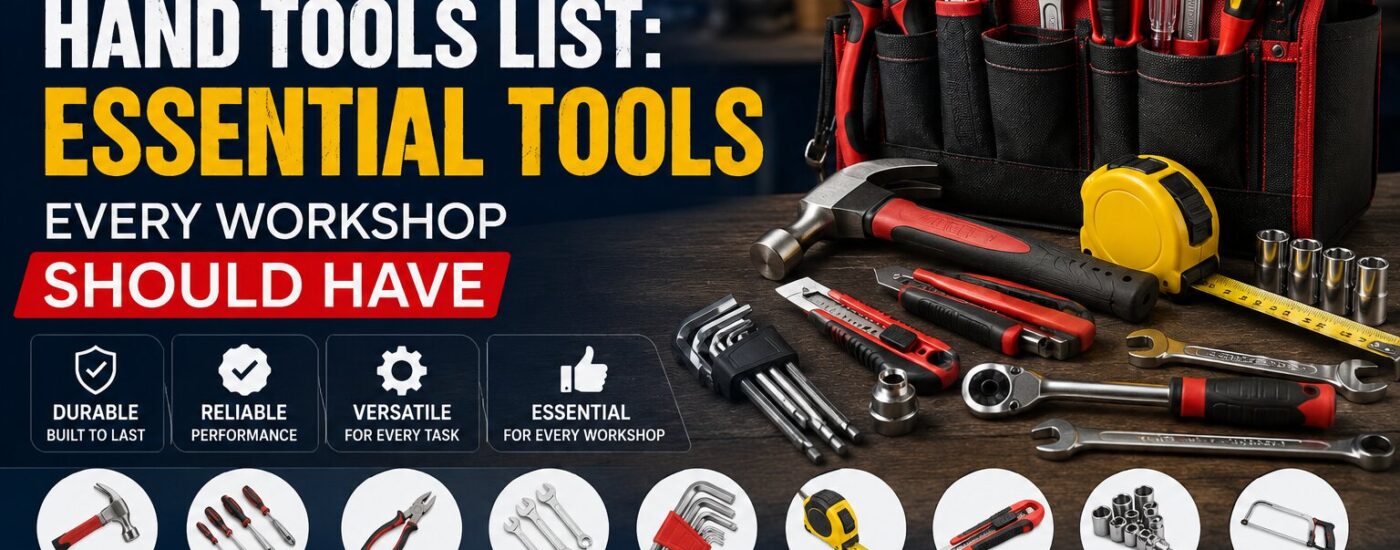
Whether you work in construction, automotive, manufacturing, or maintenance — the right hand tools are the backbone of your work. Here is a practical guide to 10 must-have hand tools, what each one does, and how to choose the best one for your needs.
Quick Answer — What are the 10 essential hand tools?
The 10 most essential hand tools every professional should own are:
- Hammer
- Screwdriver
- Pliers
- Wrench / Spanner
- Handsaw
- Chisel
- Measuring Tape
- Torque Wrench
- File & Rasp
- Pry Bar / Crowbar
The 10 Essential Hand Tools List — Explained
Hammer
The hammer is the most universally recognized hand tool. Used for driving nails, breaking materials, and light demolition, it is indispensable in construction, carpentry, and general maintenance. Common types include the claw hammer, ball-peen hammer, and sledgehammer.
Screwdriver
Designed specifically to drive in or remove screws, screwdrivers are among the most frequently used hand tools across all industries. Types include flathead, Phillips, Torx, and Pozidriv. They are essential in manufacturing, repair, and electrical work.
Pliers
Pliers grip, bend, cut, and pull with mechanical advantage. They are critical in electrical work, plumbing, and automotive repairs. Types include needle-nose, locking, combination, and cutting pliers, each suited to a different application.
Wrench / Spanner
Wrenches grip and adjust nuts and bolts. They are essential in automotive, plumbing, and engineering applications. Key types include open-end, box-end, combination, adjustable, and Allen wrenches. Chrome-vanadium steel is the standard material for professional-grade wrenches.
Handsaw
The handsaw cuts wood, PVC, and other materials without the need for power. Types include rip saws, crosscut saws, hack saws (for metal), and tenon saws (for joinery). They offer portability and precision that power saws sometimes cannot match in tight spaces.
Chisel
Chisels cut and shape wood, stone, or metal by striking with a mallet. Woodworking chisels, cold chisels, and masonry chisels each serve a distinct purpose. They deliver clean, controlled material removal that power tools often cannot replicate.
Measuring Tape
A measuring tape is the cornerstone of accuracy in any trade. Used in construction, interior design, plumbing, and carpentry, a good tape measure ensures correct dimensions before cutting or placing materials. Look for a locking mechanism and a durable housing.
Torque Wrench
A torque wrench applies a precise amount of rotational force to a fastener, preventing over-tightening and ensuring safety. It is critical in automotive, aerospace, and engineering applications. Both manual (click-type) and digital versions are widely used by mechanics.
File & Rasp
Files are used by mechanics to smooth rough metal edges, remove burrs, and fine-tune surfaces. Rasps have coarser teeth ideal for shaping wood or soft materials. They remain one of the most precise finishing tools available without electricity.
Pry Bar / Crowbar
Pry bars and crowbars are extremely durable hand tools essential to construction and demolition projects. They are used to remove nails, pull apart structures, lift heavy objects, and provide the leverage needed where hands alone cannot do the job.
