
Diamond Wheel Dresser vs Other Dressing Tools: Which Is Better?
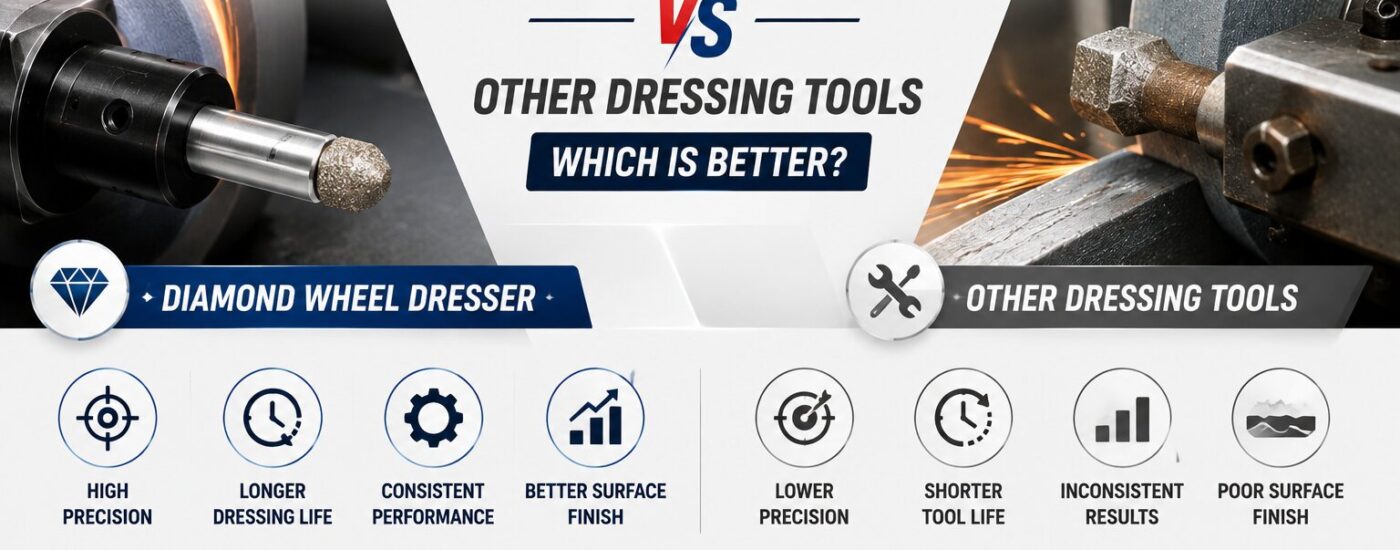
Grinding wheels gradually lose their reducing efficiency as abrasive grains become stupid, surfaces come to be clogged, or the wheel profile changes. Wheel dressing restores the cutting floor and helps hold grinding accuracy, floor finish, and productivity. Among the distinct dressing techniques to be had, diamond wheel dressers are extensively used for precision grinding applications.
But how does a diamond wheel wardrobe examine with other dressing gear? The proper desire depends at the grinding wheel, material, required accuracy, production extent, and application.
What Is a Diamond Wheel Dresser?
A diamond dresser is a dressing tool that uses a diamond or diamond-based cutting element to remove worn abrasive material from a grinding wheel. It exposes fresh abrasive grains and restores the desired wheel geometry.
Diamond is particularly suitable for precision dressing because of its exceptional hardness and wear resistance.
Key advantages include:
- High dressing accuracy
- Excellent profile control
- Long tool life
- Consistent grinding performance
Common Types of Grinding Wheel Dressing Tools
Before comparing them, it is useful to understand the main dressing options used in grinding operations.
1. Diamond Wheel Dressers
Diamond dressers are commonly selected for applications where precision and consistency are important. They can be used to dress and form grinding wheels accurately.
2. Abrasive Dressing Tools
Abrasive dressers use materials such as silicon carbide or other abrasive compounds to condition grinding wheels. They can be suitable for less demanding applications where extremely precise profiling is not required.
3. Rotary Dressers
Rotary dressers use a rotating dressing surface or cutting elements to condition grinding wheels. They are often used in automated and high-production grinding environments.
4. Crush Roll Dressers
Crush roll dressing uses a shaped roll to generate a specific grinding wheel profile. It is particularly useful for high-volume production where the same profile needs to be reproduced consistently.
Diamond Wheel Dresser vs Other Dressing Tools
The biggest difference between diamond dressers and conventional dressing tools is the combination of hardness, precision, and profile control.
| Factor | Diamond Wheel Dresser | Abrasive Dresser | Rotary Dresser | Crush Roll |
|---|---|---|---|---|
| Precision | Very high | Moderate | High | Very high |
| Profile control | Excellent | Limited | Excellent | Excellent |
| Tool life | High | Moderate | High | High |
| Automation suitability | High | Moderate | Excellent | Excellent |
| Initial cost | Moderate to high | Generally lower | Higher | High |
| Best suited for | Precision grinding | General applications | Production grinding | High-volume profiling |
The table provides a general comparison; actual performance depends on the specific tool design and grinding application.
Why Choose a Diamond Wheel Dresser?
A diamond wheel dresser can be a strong choice when grinding operations demand dimensional consistency and controlled wheel geometry.
Better Profile Accuracy
For applications involving complex or precise wheel profiles, diamond dressing tools can provide accurate control over the grinding wheel’s shape.
Consistent Surface Finish
A properly dressed wheel exposes fresh abrasive particles and helps maintain predictable grinding characteristics, contributing to consistent surface finishes.
Longer Working Life
Diamond’s high hardness allows the dressing element to withstand repeated contact with abrasive grinding wheels. Proper operating conditions and dressing parameters are still essential for achieving expected tool life.
Suitable for Precision Applications
Diamond wheel dressers are commonly considered for precision machining environments where dimensional accuracy and repeatability are important.
When Should You Choose Another Dressing Tool?
A diamond dresser isn’t automatically the best option for every grinding operation. Other dressing technologies may be more appropriate depending on production requirements.
Consider alternatives when:
- The application has relatively low precision requirements.
- A specialized automated dressing process is needed.
- A fixed complex profile must be reproduced in high-volume production.
- The overall tooling budget favors a different dressing method.
- The grinding wheel and machine setup require a specialized dressing system.
The correct choice should therefore be based on the complete grinding process rather than the dressing tool alone.
Factors to Consider Before Buying a Diamond Wheel Dresser
Selecting the right dresser requires more than simply choosing a diamond tool. Consider the following:
Grinding Wheel Type
Different abrasive wheels have different dressing requirements. Consider the wheel’s abrasive material, hardness, bond type, and dimensions.
Required Accuracy
If the application involves tight dimensional tolerances or complex profiles, dressing accuracy becomes particularly important.
Machine Compatibility
Check the dresser’s dimensions, mounting arrangement, operating conditions, and compatibility with your grinding machine.
Production Volume
High-volume applications may require a dressing solution optimized for repeatability, automation, and predictable tool life.
Dressing Parameters
Dressing speed, depth of cut, feed rate, and coolant conditions can influence wheel performance and dresser life. Follow the tool manufacturer’s recommended parameters.
How to Get Better Performance from a Diamond Dresser
Even a high-quality diamond dresser needs correct handling and operating conditions.
- Use appropriate dressing parameters.
- Maintain proper coolant flow where applicable.
- Avoid unnecessary impact or vibration.
- Maintain accurate dresser positioning.
- Inspect the dressing element regularly.
- Follow the manufacturer’s operating recommendations.
For manufacturers evaluating precision grinding solutions, suppliers such as Vermaent can be considered when sourcing diamond wheel dresser solutions and related grinding-wheel tooling based on the specific machine and application requirements.
Which Dressing Tool Is Better?
There isn’t any popular winner. Diamond wheel dressers are commonly a strong choice for precision, profile accuracy, consistency, and demanding grinding applications, while different dressing tools can provide blessings for specific manufacturing environments, wheel kinds, or specialized procedures.
The fine solution relies upon to your grinding wheel, gadget, production extent, required tolerances, surface-end requirements, and overall running price.
Conclusion
Choosing among a diamond wheel wardrobe and other dressing tools must be primarily based on utility necessities in place of fee by myself. Diamond dressers provide great precision, profile control, consistency, and durability, making them nicely desirable to many traumatic grinding operations.
For high-precision grinding, the right diamond wheel wardrobe can assist hold wheel geometry and guide consistent machining results. However, rotary dressers, abrasive dressers, and crush rolls can be extra appropriate for precise automatic or high-quantity packages. A careful assessment of your complete grinding procedure will help you select the maximum suitable dressing technology.
