
Cordless vs Corded Power Tools: Which One Delivers Better Value for Professionals?
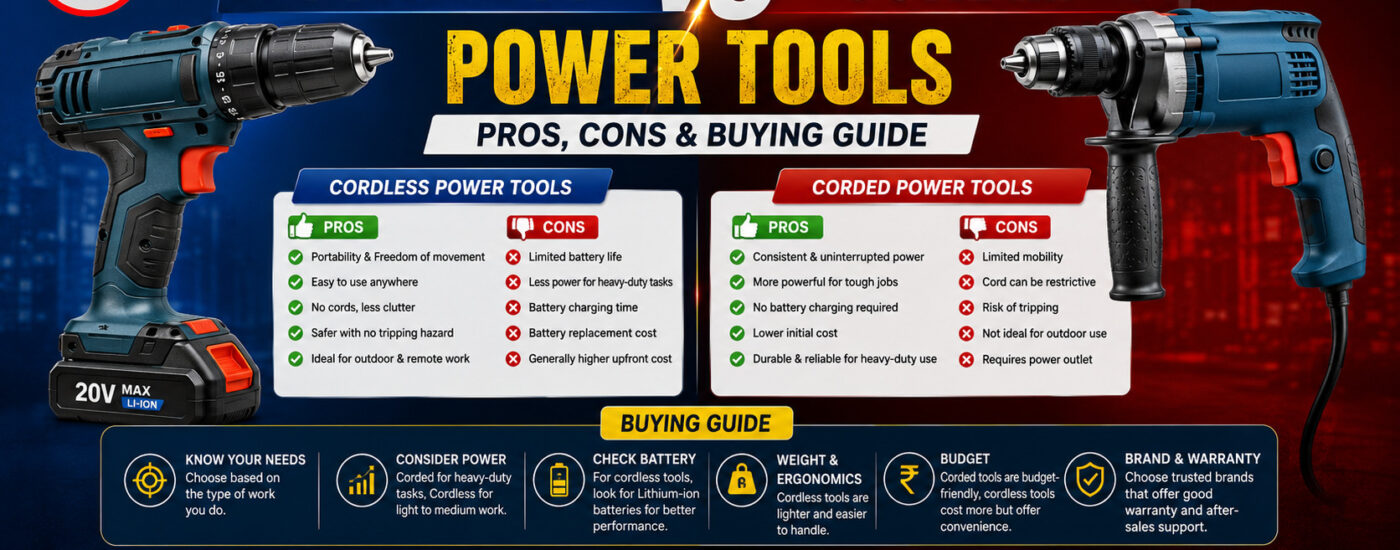
Today, power tools are necessary in the building, manufacturing, woodworking, metal fabrication and maintenance industries. One of the most frequently asked questions by professionals is: Cordless vs Corded Power Tools – which is the best? The answer will rely on performance needs, mobility, runtime, type of project and long term expenses.
This book takes a detailed look at cordless and corded power tools to assist businesses and professionals make the correct decision to maximise productivity and return on investment.
Quick Answer: Cordless vs Corded Power Tools
If mobility and convenience are your priorities, cordless power tools are the better option. If you require continuous power, heavy-duty performance, and lower upfront costs, corded power tools often provide greater value.
The best choice depends on your work environment, frequency of use, and project demands.
What Are Cordless Power Tools?
Cordless power tools operate using rechargeable battery packs instead of a direct electrical connection. Advances in lithium-ion battery technology have significantly improved their power, efficiency, and runtime.
Common cordless tools include:
- Cordless drills
- Impact drivers
- Circular saws
- Angle grinders
- Rotary hammers
- Nail guns
Key Benefits of Cordless Power Tools
- Greater mobility and flexibility
- Ideal for remote job sites
- Reduced tripping hazards
- Faster setup and movement between tasks
- Improved convenience for professionals working in multiple locations
What Are Corded Power Tools?
Corded power tools receive electricity directly from a power outlet through a cable. They have been a trusted choice for industrial and professional applications for decades.
Common corded tools include:
- Electric drills
- Angle grinders
- Cut-off machines
- Demolition hammers
- Circular saws
- Sanders
Key Benefits of Corded Power Tools
- Continuous power supply
- Consistent performance under heavy loads
- No battery charging downtime
- Typically lower initial purchase cost
- Suitable for extended industrial operations
Cordless vs Corded Power Tools: Detailed Comparison
1. Power and Performance
Corded tools usually provide more and more consistent power output. They are suited for hard tasks such as drilling concrete, cutting metal and continuous manufacturing work.
While modern cordless tools have come a long way, heavy industrial applications may still benefit from corded instruments.
Winner: Corded Power Tools
2. Portability and Convenience
Cordless tools excel when workers need to move frequently across large sites or work in areas without easy access to electrical outlets.
Electricians, maintenance technicians, and field service professionals often prefer cordless solutions because they eliminate cable restrictions.
Winner: Cordless Power Tools
3. Runtime and Continuous Operation
Corded tools are limited only by the availability of electricity. Cordless tools are battery dependent and may require spare batteries to keep working.
Corded tools are clearly better for long duration projects.
Winner: Corded Power Tools
4. Safety on Job Sites
Busy work situations can be a trip hazard with power cords limiting mobility. Cordless tools get rid of these barriers and help you keep your workstation cleaner.
But you still need to know how to charge and use them properly.
Winner: Cordless Power Tools
5. Maintenance and Operating Costs
Corded tools generally require less ongoing investment because they do not depend on battery replacements.
Cordless tools may involve additional expenses for:
- Battery packs
- Chargers
- Battery replacements over time
Businesses should factor these costs into their purchasing decisions.
Winner: Corded Power Tools
Which Offers Better ROI?
When evaluating Cordless vs Corded Power Tools, ROI depends on how the tools are used.
Cordless Tools Offer Better ROI When:
- Mobility is essential
- Teams work across multiple locations
- Faster task completion improves productivity
- Worker efficiency is a priority
- Access to power sources is limited
Corded Tools Offer Better ROI When:
- Tools operate for long hours daily
- Heavy-duty applications are common
- Continuous power is required
- Budget considerations are important
- Manufacturing or workshop environments are involved
For many businesses, a combination of both tool types provides the highest overall return on investment.
Best Industries for Cordless Power Tools
Cordless tools are particularly beneficial in:
- Electrical installations
- HVAC services
- Facility maintenance
- Residential construction
- Interior fit-outs
- Roofing and outdoor projects
Their flexibility allows technicians to work efficiently without being restricted by cables.
Best Industries for Corded Power Tools
Corded tools remain a preferred choice for:
- Manufacturing facilities
- Fabrication workshops
- Industrial maintenance
- Heavy construction projects
- Metalworking operations
- Continuous production environments
These applications often demand maximum power and uninterrupted operation.
Future Trends in Power Tools
The power tool sector is still growing significantly. Battery technology improves every year, providing longer runtimes, faster charging and better performance. Many manufacturers are investing considerably in cordless ecosystems that enable a variety of products to share the same battery platform.
Despite these advances, corded tools still occupy a significant place in heavy-duty industrial applications where steady power remains vital.
Conclusion
The debate around Cordless vs Corded Power Tools does not have a one-size-fits-all answer. Cordless tools provide unmatched portability, flexibility, and convenience, making them ideal for mobile professionals. Corded tools deliver continuous power, reliability, and lower long-term operating costs for demanding industrial environments.
For businesses looking to maximise productivity and ROI, the smartest approach is often to assess specific job requirements and invest in the tool type that best supports operational efficiency.
