
Wrench vs Spanner: Key Differences, Types & Uses
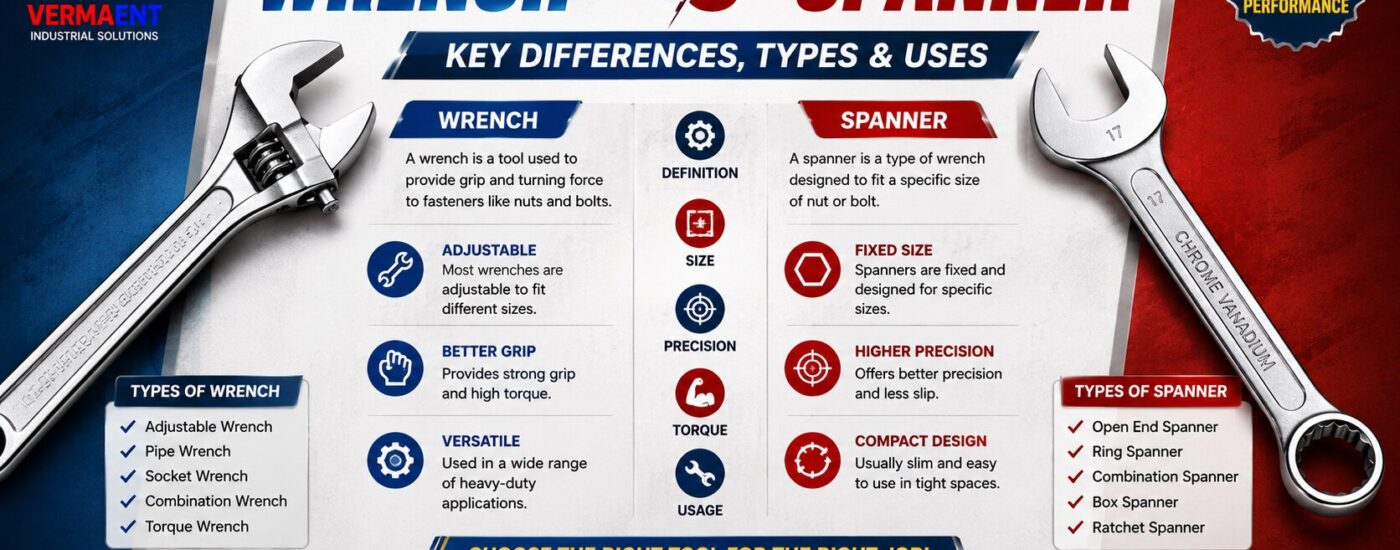
Quick Answer: A spanner is the term commonly used in the UK and India for a tool that tightens or loosens nuts and bolts. A wrench is the American English term for the same tool but in technical contexts, wrenches also include more complex tools like torque wrenches and pipe wrenches. All spanners are wrenches, but not all wrenches are spanners.
If you have ever stood in a hardware store wondering whether to pick up a spanner or a wrench — you are not alone. This confusion trips up beginners and seasoned mechanics alike, mainly because the answer depends on where you live. Whether you call it a wrench vs spanner, the debate comes down to geography, terminology, and the specific task at hand.
This guide breaks down everything you need to know — clearly, concisely, and in plain language.
What Is a Spanner?
A spanner is a hand tool with fixed or adjustable jaws used to grip, turn, and tighten or loosen nuts and bolts. The word ‘spanner’ is widely used in the UK, India, Australia, and most Commonwealth countries.
Common types of spanners:
- Open-End Spanner — has a U-shaped opening; fits specific nut sizes
- Ring Spanner — closed loop head; provides 360° grip for better torque
- Combination Spanner — open-end on one side, ring on the other
- Adjustable Spanner — movable jaw accommodates multiple sizes
What Is a Wrench?
In American and Canadian English, a wrench is the general term for any tool used to apply torque to turn fasteners. In technical contexts, wrenches also cover a broader category of more specialised tools.
Common types of wrenches:
- Socket Wrench — uses interchangeable sockets; ideal for deep or recessed bolts
- Torque Wrench — applies a precise, measurable amount of torque
- Pipe Wrench — grips and turns pipes and round objects
- Allen Wrench (Hex Key) — fits hexagonal socket screws
- Ratchet Wrench — allows tightening without repositioning the tool
Wrench vs Spanner: Key Differences at a Glance
Here is a direct side-by-side comparison to settle the wrench vs spanner debate once and for all:
| SPANNER | WRENCH |
| Term used in UK, India & Commonwealth nations | Term used in USA and Canada |
| Typically refers to fixed or adjustable jaw tools | Broader term including specialised tools |
| Best for standard nuts and bolts (metric sizes) | Best for SAE/imperial or specialised fasteners |
| Compact and thin; fits tight spaces easily | May be larger; includes ratchet and torque designs |
| Example: combination spanner, ring spanner | Example: torque wrench, pipe wrench, socket wrench |
Key takeaway: All spanners are wrenches, but not all wrenches are spanners.
Adjustable Spanner vs Adjustable Wrench
The adjustable spanner (called an adjustable wrench in the US) is the most versatile single tool in any toolbox. Its movable lower jaw can be repositioned to grip fasteners of different sizes, eliminating the need to carry an entire set of fixed spanners.
Ideal for: plumbing repairs, bicycle maintenance, automotive work, and household DIY tasks. One adjustable spanner can replace multiple fixed-size tools when space and budget are limited.
When to Use a Spanner vs Wrench?
| Scenario / Task | Best Tool to Use |
| Tightening metric nuts and bolts | Spanner (combination or ring) |
| Torquing engine components to spec | Torque Wrench |
| Gripping and turning water pipes | Pipe Wrench |
| Working in tight or awkward spaces | Combination Spanner or Ratchet Wrench |
| Removing rusted or seized bolts | Ring Spanner or Socket Wrench |
| General household maintenance | Adjustable Spanner / Adjustable Wrench |
Why Getting the Right Tool Matters
Using the wrong tool is not just inefficient — it is a safety risk. An ill-fitting spanner can slip off a bolt, rounding off the edges and causing injury. Industry data shows that using a mismatched wrench increases slippage risk by up to three times, especially in high-torque mechanical applications.
Understanding the difference between spanner and wrench helps you build a smarter, leaner toolbox — one stocked with exactly what each job demands.
Conclusion
In the end, wrench vs spanner is a question of language as much as it is a question of tool. The word spanner is used in India and the UK. You say wrench in the US. A wrench is a broader term used in technical settings. For best results, choose tools that fit your fastener precisely, match your engine or application, and give you the control and torque you need.
The right hand tool can make every job faster, safer, and more precise whether you are a mechanic, an ITI trainee, or a DIY enthusiast at home.
